First edition · 2026

Longevity
Decoded.

Last reviewed:

The evidence-based visual guide to longevity

More years. Less hype. Start with the levers that matter, then examine the molecules, measurements and protocols being sold in the name of a longer life.

By Cam Hughes37 chapters325-page PDFReflowable EPUB
A$24.00 AUD · launch price

Standard price A$34.00 AUD

PDF + EPUB included
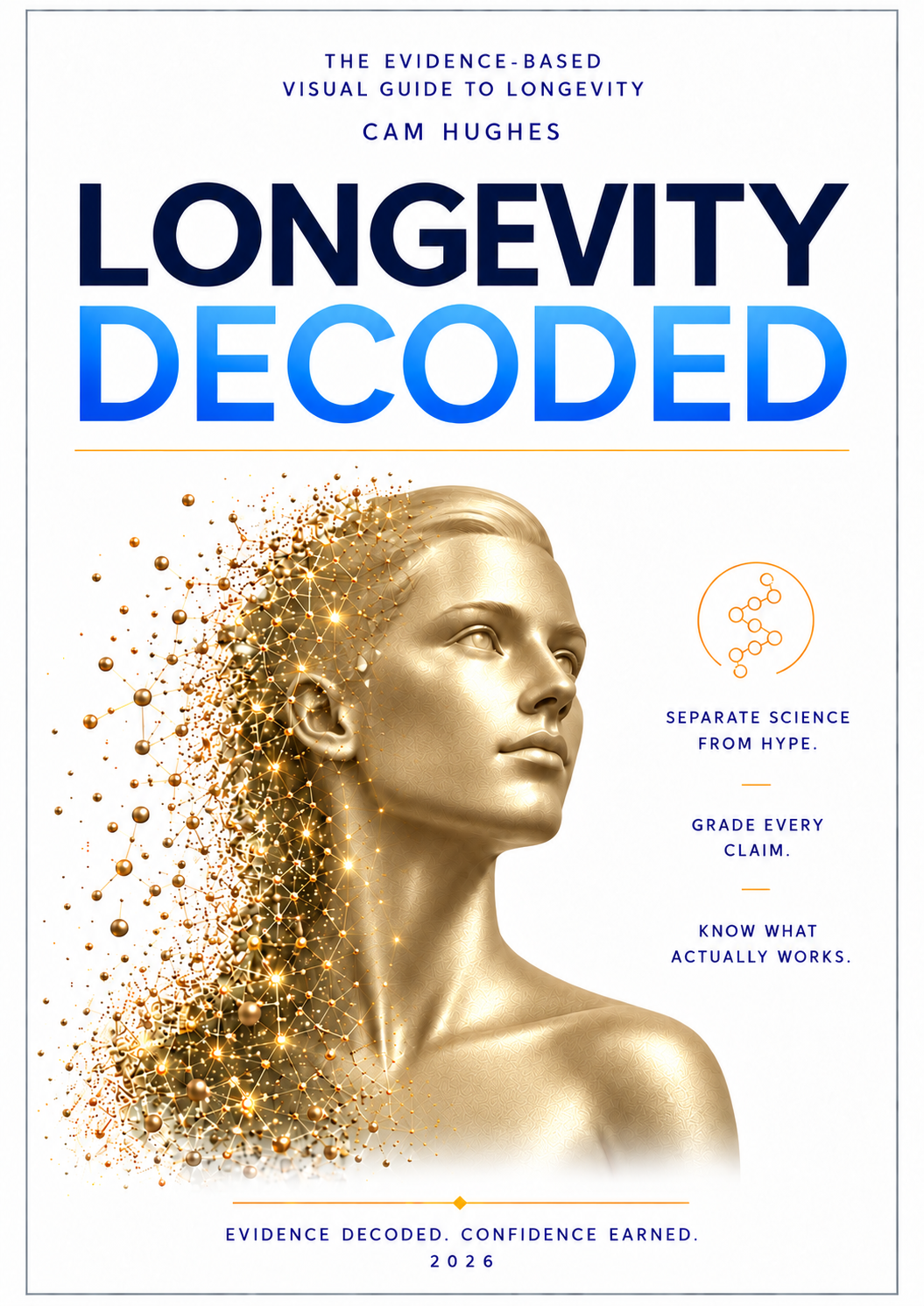
Approved cover of Longevity Decoded by Cam Hughes

Inside the book

What was tested?
What did it show?

A changed biomarker is not a longer human life. The evidence-tier layer keeps the study setting and the actual outcome visible, so promising research cannot quietly become a promise to you.

  1. 01
    37 chapters across six partsA claim decoder, everyday levers, molecules, measurement, protocols and clinics, then building a plan and getting good care. Approximately 73,108 narrative words.
  2. 02
    A grade belongs to one claimA–E assessments stay tied to the human evidence for a particular intervention, form or route, research exposure, outcome and population. Ungraded records retain their reasons.
  3. 03
    Two lines that change the reading“Tested in” and “What it’s been shown to do” distinguish human, animal and cell evidence—and mortality, function, biomarkers and mechanisms.
  4. 04
    Mouse findings keep their speciesSelected mouse-only records carry a small mouse mark and remain ungraded. A stack is assessed on its own evidence, not its components’ grades.
  5. 05
    Levers first. Spend last.Exercise, strength, sleep, nutrition and connection come before the molecules. Comparison tables, Plain Lane summaries and linked references help you inspect a claim.

Your digital editions

One complete book.
Two ways to read.

Choose the original page design or text that adapts to your screen. Both editions include all 37 chapters, the references and the front and back matter.

Designed PDF

325 designed pages with prominent evidence-tier verdict cards, comparison tables, safety callouts and restrained teaching illustrations. Linked Contents, bookmarks and a verdict index support reference reading.

3.3 MB · ISBN 978-1-7649116-8-9

Reflowable EPUB

Reflowable text for compatible reading apps and e-readers, with adjustable text size, semantic headings, linked navigation and text alternatives for figures.

3.2 MB · ISBN 978-1-7649116-9-6

Published by Decoded Press · By Cam Hughes · First edition, 2026.

Educational and non-prescriptive. Research exposures are descriptions of studies, never reader doses. Safety accompanies each item; care decisions belong with a qualified clinician.

By Cam Hughes, Decoded Press.

The method, in plain view

How to read the grades

A grade belongs to a defined claim: the form or route, outcome and studied population matter. Read the explanation beside the letter.

Grade A: Strong and directly relevant
Grade B: Supportive with meaningful limits
Grade C: Uncertain, mixed or modest
Grade D: Little reliable support
Grade E: No meaningful benefit, or an unfavorable proposition

Tested in / What it’s been shown to do: the cards distinguish humans, animals and cells, and separate mortality, function, biomarkers and mechanisms. Mouse-only evidence records stay ungraded.

Missing research is not the same as evidence of no benefit. E does not mean “we do not know.”

Research and its limits stay together, including what has not been established. A grade is not a treatment recommendation or a guarantee of personal benefit.

Questions, answered with context.

Does an improved biomarker prove a longer life?

No. A better blood result does not by itself establish longer life. Read the grade alongside the study setting and the outcome that was actually measured.

Source: Longevity Decoded, Chapter 4, pp. 33–34.

Can the same ingredient have different evidence grades?

Yes. Grades belong to specific claims and outcomes. Evidence for one outcome does not automatically support a different claim, and a combination needs its own evidence.

Source: Longevity Decoded, Chapter 4, p. 34.

Does a strong benefit grade settle the safety question?

No. A benefit grade does not remove interactions, exclusions or monitoring needs. Short-term tolerability also provides limited information about long-term use.

Source: Longevity Decoded, Chapter 4, p. 33.

Read your way

An EPUB that adapts to you.

Adjustable text size, semantic headings, linked navigation and text alternatives for figures help you read in compatible apps and e-readers.

Reading features vary by app and device. Ask us about accessibility →

Try a chapter before you buy

Free sample: how the evidence grades work

Get the free “How the grades work” chapter from Longevity Decoded. See how the claim, study setting and outcome sit beside every verdict.

Read the free sample PDF →

Request the free Longevity chapter by email. Marketing is optional.

The Complete Library · PDF + EPUB

Complete Library bundle: all five books

Peptides Decoded Volumes One and Two, Supplements Decoded, Menopause Decoded and Longevity Decoded. All five books, each in PDF + EPUB.

Build your reference shelf in PDF + EPUB. Five complete books. Ten digital editions.

A$99.00 AUD

Save A$71 against five standalone standard prices of A$34. During the launch offer, those five total A$140—a saving of A$41.

Weight Loss Decoded joins the bundle when it launches. It is not included in this five-book collection.

Reader feedback

From our readers

No reader reviews published yet. Read the book? Tell us what helped and what could be clearer.

Share your review →

Include the book title and your preferred display name. We’ll ask your permission before publishing your words.